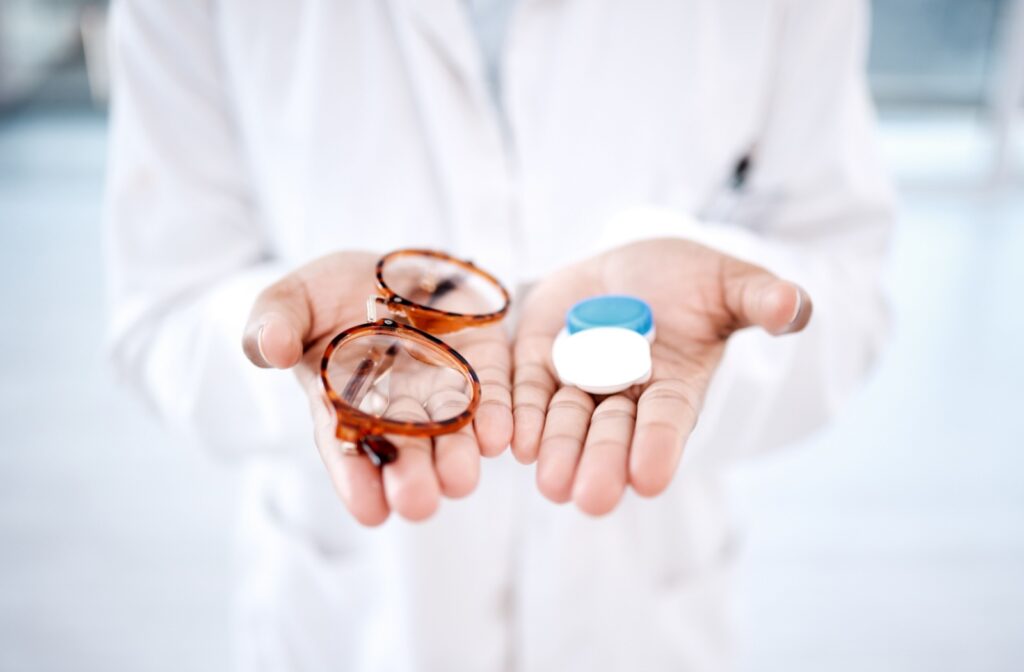
You have your glasses prescription in hand and see a great deal online for contact lenses. You might be tempted to just use the numbers from your glasses prescription and order them. It seems like it should be simple enough: After all, how different could they really be? Our team at Karns Vision Center wants you to understand why this isn’t a good idea.
No, contact lens prescriptions and glasses prescriptions are not the same, and you shouldn’t use one to purchase the other. While they both correct your vision, they work in very different ways and require unique measurements for a safe and accurate fit, which is why a separate contact lens exam is necessary.
The Simple Answer
A Difference in Distance
The biggest reason for the difference comes down to distance. Your glasses rest a short distance away from your eyes, usually about 10–14 millimeters. This space affects how the light focuses to correct your vision.
Contact lenses, on the other hand, sit directly on the surface of your eyes. Because there is no distance between the lens and your eye, the power required for clear vision often changes, especially in higher prescriptions. This is why the numbers on each prescription are different.
Key Information on Your Glasses Prescription
When you look at a prescription for glasses, you see several numbers. Each has a distinct job to help you see better through your frames.
- Sphere (SPH): This indicates the main lens power needed to correct nearsightedness or farsightedness.
- Cylinder (CYL) and axis: If you have astigmatism, an imperfection in your eye’s curve, these numbers provide the extra correction needed.
- Pupillary distance (PD): This is the measurement of the space between your pupils. It helps center the lenses in your eyewear frames for the clearest view.
All these measurements work together to create a visual “sweet spot” in your glasses. When the pupillary distance is correct, your eyes look through the center of the lenses, giving you the sharpest vision possible.
What Makes a Contact Lens Prescription Special
A contact lens prescription includes information that a glasses prescription doesn’t. These extra details are all about how the lens fits your eye shape, which is important for both comfort and health.
Base Curve and Diameter
Your eyes have a specific curve, and your contact lenses need to match it. The base curve (BC) measurement makes sure the lens sits smoothly on your eye without being too tight or too loose. The diameter (DIA) is the size of the lens, which determines how it covers your eye’s surface.
Lens Brand and Material
Contact lenses also come in many different materials. Some allow more oxygen to reach your eye, while others are designed to retain moisture. An eye care professional can recommend a specific brand and material that fits your lifestyle and supports your long-term eye health.
The eye doctor can also discuss your options for a wear schedule. You might prefer daily disposable lenses for their convenience and hygiene, or perhaps bi-weekly or monthly lenses are a better fit for your routine. This choice is an important part of your prescription and is based on your specific needs.

Why You Can’t Convert a Prescription Yourself
Trying to guess your contact lens prescription from your glasses is not a good idea. The lens power needs to be adjusted by an eye doctor to account for the difference in distance from your eye. An incorrect power or fit can lead to blurry vision, discomfort, or even headaches.
An improperly fitting contact lens can cause more than just frustration. It could lead to dry, irritated eyes or slide out of place when you blink. In some cases, a lens that is too tight can reduce oxygen flow, which is important for keeping your eyes healthy.
The Need for a Contact Lens Exam
A contact lens exam goes beyond a standard eye exam. It involves an eye doctor taking precise measurements of your eye’s surface to find the right base curve and diameter, as well as checking how the lens fits and moves on your eye to prevent potential issues.
A Trial Period
Your exam may include a trial period with a pair of diagnostic lenses. You’ll wear them for a few days or a week to see how they feel in your daily life. A follow-up visit helps the eye doctor to check the fit and your vision one last time before finalizing the prescription.
Schedule Your Contact Lens Exam
If you’re ready to explore the freedom that contact lenses offer, our team at Karns Vision Center would love to see you. Schedule a visit for a dedicated contact lens fitting to find the right option for your eyes.